A business can have an attractive website, strong customer service, and plenty of local customers yet still be missing from the map results people see first. Understanding the Google Local Pack ranking factors in 2026 helps explain why that happens and what a business owner can realistically improve. Google does not provide a secret checklist or fixed scoring formula. It does explain the fundamentals, and current industry research gives us a useful way to prioritize the work.
Quick answer: Google Local Pack results primarily depend on relevance, distance, and prominence. An accurate Google Business Profile, appropriate categories, real-world location, legitimate customer reviews, and a helpful local website support those fundamentals. No single tactic guarantees a top-three listing because results vary by search query, location, competition, and other context.
Key Takeaways
- Google’s official local ranking framework centers on relevance, distance, and prominence; no public percentage formula exists.
- The primary Google Business Profile category and the searcher’s distance from a business are particularly important in the 2026 expert survey.
- Reviews matter for local reputation and visibility, but paying for reviews or filtering requests toward happy customers creates policy risk.
- Accurate business details, relevant website pages, and trustworthy mentions support your local presence without requiring hundreds of low-quality directory listings.
- Photos and posts help customers understand your services; claims that daily posting automatically raises rankings are not established by Google’s documentation.
- Service-area businesses must follow eligibility and address-display rules, even when another type of listing appears to rank more strongly.
- Track local search visibility from several geographic points alongside calls, directions, website visits, and qualified leads.
What Is the Google Local Pack?
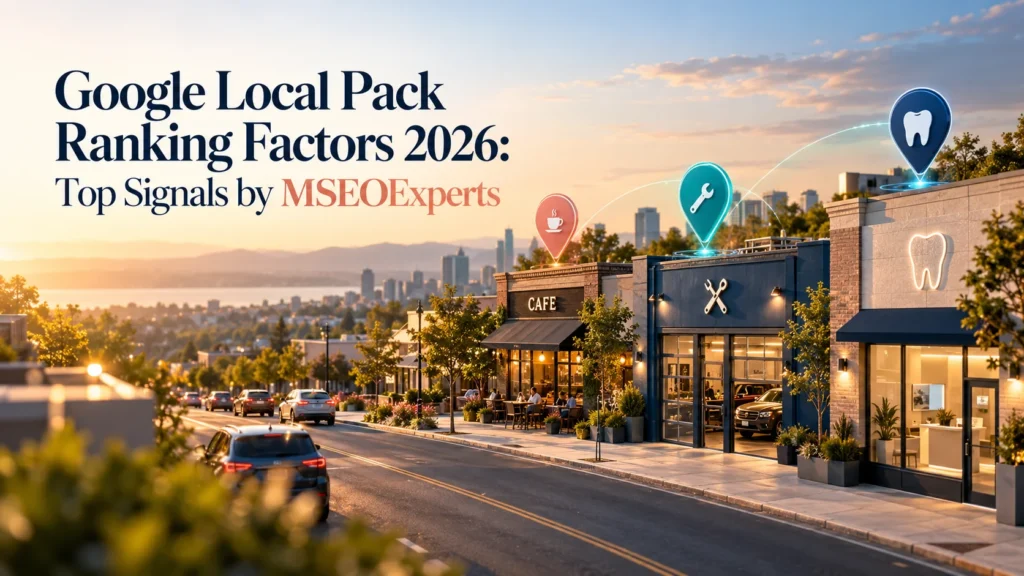
The Google Local Pack, also called the Map Pack or local three-pack, is the group of nearby business results that Google may show when a search suggests local intent. It often includes a map and a small selection of business profiles with ratings, hours, directions, or other useful details. The exact display can change by query, device, and Google product.
For example, someone searching for “emergency plumber near me” probably wants a provider who can respond quickly. Someone searching “family dentist in Austin” may compare several offices before booking. Both searches can trigger local results, yet the order can differ because search intent and search location differ.
A Local Pack result is not identical to an ordinary blue-link website result. A company might have a website that ranks well organically but perform poorly in Maps, or the reverse. The business profile, its eligibility, real-world location, and reputation are central to the local experience. Its website still matters because it clarifies what the company offers and provides evidence of its local presence.
The goal should not be to appear in the same position for every person in a city. That is rarely realistic. The better goal is to show up for relevant services in the areas where customers are likely to choose you, and to turn those appearances into useful customer actions. If you need the fundamentals of the feature itself, start with MSEOExpert’s guide to ranking in Google’s 3-pack.
How Google Determines Local Rankings
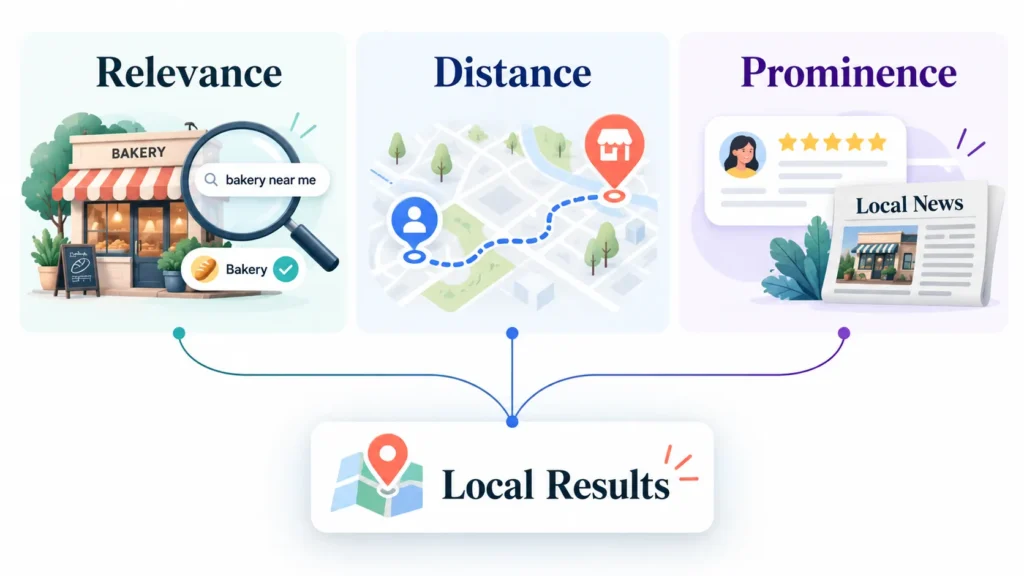
Google describes three main considerations: relevance, distance, and prominence. These are the foundation for evaluating the more specific factors discussed below. They are not independent switches you can turn on. They interact with the wording of the search and with each searcher’s context.
Relevance: Match the Customer’s Need
Relevance describes how closely a business matches a search. A profile classified as a roofing contractor has a clearer relationship to “roof repair” than a general home-improvement listing with unrelated services. Useful details about actual services, categories, and business operations give Google more context about what the company does. B2B Listings
A practical relevance audit asks whether a customer could tell, within seconds, which specific services the business provides. If you sell and install replacement windows, for instance, distinguish those services from window cleaning. Use the most accurate primary category, select only applicable secondary categories, and describe services in plain language. Your website should reinforce the same legitimate offerings.
Distance: Where the Search Takes Place
Distance is the separation between a business and the searcher or another location implied by the query. For searches without an explicit city, Google can use information it has about the user’s location. That means two people searching the same words from different neighborhoods may see different businesses.
This is why a single screenshot from an office computer cannot prove a company ranks throughout a metro area. Even a highly reputable business can be less visible farther from its real location. Proximity is largely a constraint, not a signal that can be purchased or changed through keyword repetition.
Prominence: How Well Known the Business Is
Prominence reflects how established and recognized a business appears. Google’s official local ranking guidance mentions signals such as reviews and links from websites. Strong reputation, credible references, and useful information can help demonstrate that a business exists and is worth considering.
Prominence does not mean collecting the most mentions at any cost. A genuine reference from a local organization, industry association, or community publication can be more meaningful to customers than dozens of irrelevant directories. Likewise, the quality and authenticity of customer feedback matter more than manufacturing a perfect-looking profile.
Which Ranking Signals Matter Most in 2026?
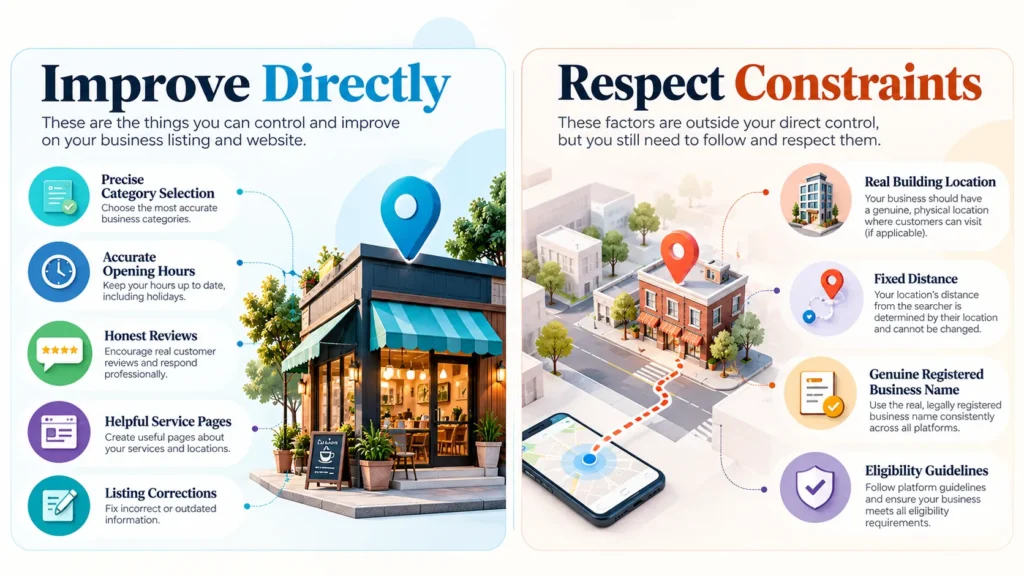
The 2026 local search ranking factor survey by Whitespark asked 47 industry experts to rate 187 possible factors. Their highest-rated Local Pack signals included the primary GBP category, proximity to the searcher, keywords in business titles, physical location within the city searched, being open at search time, and Google reviews. These scores summarize expert observations, not a published Google algorithm or guaranteed cause-and-effect relationships.
| Signal | What it means | How much control you have |
|---|---|---|
| Primary GBP category | Main classification of the business | High, within accuracy rules |
| Searcher-business distance | Real-world proximity to the search | Very limited |
| Business name relevance | Words in the genuine registered or public-facing name | Do not manipulate |
| Open status and hours | Whether stated operating hours fit the query time | High, but must be truthful |
| Reviews and ratings | Genuine customer feedback and reputation | Moderate, through service and ethical requests |
| Additional categories and services | Accurate description of other offerings | High, within relevance rules |
| Website relevance | Useful, accessible pages supporting local needs | High |
| Citations and links | Consistent records and third-party references | Moderate |
Notice that some surveyed items are not appropriate optimization instructions. Adding “best plumber Dallas” to a business name that is actually “Oak Street Plumbing” might appear attractive because name words correlate with rankings, but Google’s rules require the real-world business name. Likewise, inventing a city office to appear closer to searchers can put an entire profile at risk.
Strategic insight: Rank signals by both likely importance and ethical controllability. Fix a wrong primary category immediately. Correct inaccurate hours and missing services next. Build a long-term review and website program after that. Do not waste months trying to manipulate distance or a business name, because those attempts can create more problems than they solve.
Optimize GBP Categories and Services
A correct primary category is one of the most consequential choices a local business can make. Categories tell Google the business type, while services help customers understand what it actually delivers. The best setup accurately describes the company, not every search phrase it wants to rank for.
Choose the Closest Primary Category
Imagine a company primarily providing residential heating repairs but also selling a few air filters. A specific heating or HVAC service category may be a more truthful fit than an unrelated retail category. The correct selection depends on the company’s real core business and the categories Google currently offers.
Ask what the business is, rather than what products it happens to carry. Review the primary category after a genuine change in the business model, not every time rankings fluctuate. Frequent speculative changes can make measurement harder and may alter how the listing appears to customers.
Use Secondary Categories Selectively
Secondary categories should capture additional business types the company genuinely operates. A dental practice that provides a recognized specialty may qualify for an additional category; a general practice should not claim unrelated specialties merely to expand keyword reach. Categories can be a strong relevance cue, but accuracy remains the first rule.
Google may change the available category list. Do not rely on an outdated spreadsheet alone. Compare the choices inside the live profile with the real services described on the website. For a more detailed category workflow, see MSEOExpert’s Google Business Profile categories guide.
Complete Relevant Services and Attributes
Services should describe what customers can actually book or buy. Where Google provides predefined services, use relevant options and add custom services when appropriate. Attributes such as accessibility or amenities can help customers make decisions, provided they describe the location accurately.
Write for humans rather than repeating a city keyword in every service field. “Water heater installation” is understandable; “best affordable water heater installation near me in every neighborhood” is not. Add meaningful descriptions when they clarify pricing scope, appointment requirements, or common customer questions without making claims the business cannot support.
How Proximity Affects Google Maps Results
Proximity is powerful because local searches often express a desire for convenience. A search for a grocery store, urgent repair provider, or restaurant may reasonably favor closer eligible options. But distance is not a fixed-radius rule, and a closer company does not automatically win when relevance or prominence differs.
A business at the edge of a city may appear often in its own neighborhood but rarely in results from the opposite side of town. That does not necessarily mean its profile has been penalized. A map-grid ranking check can reveal the business’s actual visibility pattern across relevant search locations.
Set an Accurate Location and Map Pin
Use the real business address when eligible to show it. Verify the map pin points to the correct property, entrance, or business location where the interface allows relevant adjustments. Check address details after a move and update your website and important business records. Never relocate a pin to a city center just to chase coverage.
For a business that serves customers at their premises, the physical location is also tied to policy requirements. A warehouse with no public-facing staffed service may not qualify as a storefront. Google’s rules determine which profile configurations are acceptable, and accuracy should take priority over a temporary ranking advantage.
Understand Search Intent by Geography
“Coffee shops near me” and “best coffee shops in Brooklyn” are not the same query. The former emphasizes the searcher’s immediate position; the latter includes a named place. Business owners should monitor both if they are relevant to actual customer behavior.
You cannot legitimately optimize for every neighborhood simply by listing its name in a profile. Instead, serve your core area exceptionally well, build visibility where customers already reach you, and decide whether opening a genuine new location makes commercial sense. Local SEO cannot replace the operational work of serving a larger market.
Get Stronger Google Reviews Ethically
Authentic Google reviews can support local prominence and make it easier for searchers to select a business. Google’s documentation explicitly recognizes that more reviews and positive ratings can help local ranking. Recent feedback also reassures customers that the business is currently operating and delivering real experiences.
Build a Simple Review Request Process
Ask customers for honest feedback after a meaningful completed interaction. A service business might send a polite review link in a job-completion email. A retail store could display a QR code near checkout. The invitation should go to genuine customers without promising a reward or requiring a favorable rating.
A practical message is: “Thank you for choosing us. If you have a moment, we’d appreciate an honest Google review about your experience.” Avoid asking people to copy a prepared five-star script or to include specific search terms they did not naturally choose. Review acquisition is a customer-feedback process, not an opportunity to manufacture keyword content.
Respond with Care and Consistency
A short personal reply to praise can show appreciation. When someone reports a problem, acknowledge it, offer a private resolution channel, and avoid exposing personal information. Do not argue publicly or pressure customers to delete complaints. Criticism handled professionally can help future customers judge a business’s reliability.
Google prohibits paid or incentivized reviews, including benefits offered to change or remove negative feedback. Its review guidance and policy also encourages requesting honest reviews without manipulating which opinions are collected.
Interpret Review Signals Carefully
Review count, rating, recency, and written feedback may all be useful to assess. However, do not treat an exact review target as a universal ranking threshold. A neighborhood bakery and a large metropolitan car dealership operate in different markets, so a sensible benchmark compares similar legitimate businesses in the same local search environment.
More importantly, reviews reflect operations. If negative comments repeatedly mention missed appointments, poor communication, or unexpected charges, fix those problems. A higher-quality customer experience can improve reviews and conversions even if a specific ranking movement is difficult to isolate.
Build Website Relevance for Local Searches
A Google Business Profile and a business website should tell a consistent story. The profile introduces the business in Search and Maps, while the website can explain services, show evidence, answer questions, and turn a visitor into a customer. Website SEO is not a substitute for location eligibility, but it supports broader local discoverability.
Create Useful Service and Location Pages
A useful service page explains what the company offers, who the service is for, typical steps, service limitations, and how to contact the team. A legitimate location page should provide accurate hours, access information, contact details, and locally relevant services. It should not be a near-identical doorway page with only the city name swapped.
For example, a heating company might build one detailed furnace-repair page and one page for each staffed location. The location page can explain its real coverage, services available there, and any local differences. If a company has only one eligible location, it should not invent additional branches solely for more pages.
Strengthen Technical Basics
Make sure important pages are accessible, mobile-friendly, indexable, and easy to navigate. Use descriptive titles, useful headings, working contact buttons, and fast-loading service images. Correct broken links and avoid hiding the main service information behind elements search engines or users cannot access.
LocalBusiness structured data can help search engines interpret legitimate business details, including address and opening hours, when implemented correctly. It does not provide a guaranteed route into the Local Pack. Treat structured data as a clarity tool, validate it, and keep the page’s visible information consistent with the markup.
Match the Local Customer Journey
Consider what customers need immediately after finding your listing. A roofer may need a photo gallery and service-area explanation. A restaurant may need a menu, parking details, and booking options. A medical practice may need appointment instructions and information about accepted services. Choose content according to real buying questions, not a generic checklist.
MSEOExpert’s Google Business Profile optimization guide provides a complementary profile-level checklist. Use the website to cover the richer explanations that would make the business description unreadable.
Improve Citations and Local Authority
Local citations are mentions of a business’s name, address, phone number, or related identity details across relevant online platforms. Accurate listings make it easier for people to reach the company and can reinforce the consistency of its public information. However, submitting the same company to hundreds of low-value directories is not a reliable growth plan.
Audit Important Business Listings
Start with the major places customers and search systems may reasonably use: the business’s own website, its Google Business Profile, appropriate mapping platforms, relevant industry directories, and meaningful local organizations. Check whether each listing refers to the correct real business and location.
Prioritize wrong addresses, disconnected phone numbers, duplicates that confuse customers, and records that point to a business that has closed or moved. Small stylistic differences such as “Street” versus “St.” are generally less urgent than a customer calling the wrong phone number. MSEOExpert explains the full process in its local citation audit guide.
Earn References with Real Local Value
Local backlinks may arise through chambers of commerce, professional associations, genuine partnerships, sponsorships, news coverage, or useful community resources. The emphasis should be on relevance and legitimacy. A link received because your business contributed something meaningful is easier to justify than a paid placement in a random network.
Do not confuse citations with backlinks. A citation can mention your business without a clickable link. A backlink is a link from another site. Both may be useful for discovery and trust, but Google does not publish an exact amount of each that guarantees placement.
Avoid the Citation Volume Trap
A citation campaign should have an error-correction plan, a target list of genuinely relevant sources, and a way to maintain changes over time. If a business has moved, updating five highly visible incorrect records can be more useful than creating fifty new records with the old address.
The 2026 expert survey placed less relative emphasis on citation signals than on several profile and review signals. That finding should not be twisted into “citations don’t matter.” Accurate contact information remains an essential operational and trust requirement, especially for multi-location organizations.
Do GBP Photos and Posts Improve Rankings?
Photos and posts can make a Google Business Profile more useful, but there is an important distinction between a customer-engagement feature and a proven direct ranking factor. Google encourages businesses to add relevant media and publish updates; it does not promise that uploading a certain number of images or posts will move a listing up the local rankings.
Use Real Photos That Answer Questions
Show the outside of a storefront, the entrance customers should use, finished work, products, accessible amenities, or team members who genuinely represent the business. High-quality photos can reduce uncertainty before a call or visit. Avoid fabricated before-and-after results, heavily altered pictures, or unrelated stock images presented as customer work.
A plumber might show a clean, completed installation and the vehicle customers will recognize. A restaurant can show real dishes, seating, and entrance access. These details help people decide whether the business meets their needs. Consistent, truthful imagery is more useful than chasing an arbitrary upload quota.
Publish Posts for Business Reasons
Use Google Business Profile posts to communicate real updates: a seasonal service, a temporary schedule change, a new offering, or an upcoming event. Write a clear message and include an action that genuinely helps customers. Publishing posts solely to repeat keywords every day is not supported by a verified ranking formula.
Consider results beyond position. Did people call after seeing an offer? Did the update prevent confusion about holiday hours? Did a new product photo reduce basic questions from customers? These are good reasons to maintain the profile even without a direct ranking claim.
Service-Area and Multi-Location Businesses
Service-area businesses and multi-location companies need policies that match how they actually operate. Google distinguishes businesses that welcome customers at a staffed location from companies that travel to customers. That difference can affect what address information should appear publicly.
Follow Service-Area Business Rules
A mobile locksmith or home-based cleaning business may qualify for a service-area profile without showing its residential address. A genuine storefront that serves walk-in customers may display its eligible location. Merely selecting a large list of cities as service areas does not move the physical business closer to every searcher.
Do not create fictitious offices or use a rented virtual mailbox as a shortcut. Google’s business-representation guidelines restrict virtual-office arrangements and explain when a service-area address should be hidden. These requirements remain important even if an expert survey suggests that visible storefront addresses are associated with stronger results.
Keep Genuine Locations Separate
A regional company with separately staffed, eligible business locations should maintain correct information for each location. Each profile needs its real address, relevant categories, hours, contact methods, and appropriate location page. Brand names should stay consistent unless there is a documented real-world reason for variation.
For location pages, do more than duplicate a corporate paragraph. Give visitors location-specific directions, services, contact information, parking details when relevant, and accurate coverage areas. A single well-maintained page for each genuine branch is more valuable than a network of artificial pages for cities where no branch exists.
Avoid Duplicate Profile Confusion
Duplicate listings can split customer attention and complicate updates. Before requesting a removal or merge, verify whether a listing actually belongs to an eligible separate practitioner, department, or branch. Incorrect merges can harm legitimate visibility. Document profile ownership and make changes through authorized accounts.
A business that expands to a new city should first confirm a genuine operating location and staff arrangement, then follow Google’s eligibility and verification process. Opening a profile before those conditions exist is not a sustainable local SEO strategy.
What Changed From 2025 to 2026?
The clearest documented 2026 development is not a public announcement of a new Google ranking formula. It is a new edition of local SEO expert research, published in November 2025 for the 2026 period, plus continued evolution in how people discover businesses through Search, Maps, and AI-assisted experiences.
The 2026 Whitespark survey increased the expert-assessed importance of review and behavioral signals compared with earlier survey editions. It also added an AI-search visibility assessment. The study specifically discusses business opening status, predefined services, and changing perceptions of citation importance. Because the previous major survey edition was earlier than 2025, these results should not be presented as proof of a precise algorithm shift between January 2025 and January 2026.
Some practical areas therefore deserve more attention in 2026. Keep operating hours truthful and updated, including special hours. Make predefined services and categories accurate. Encourage genuine reviews over time. Ensure business details are clear across major customer touchpoints. These improvements are worthwhile even when the exact causal contribution to rankings is uncertain.
AI-generated search experiences may use business information, reviews, websites, and other sources to help people choose local providers. Yet Google Business Profile optimization and visibility in an AI-generated answer are different measurement problems. A company should avoid claims that one profile field guarantees inclusion in AI summaries.
Pro tip: When a new “2026 ranking factor” claim appears, ask whether it comes from Google documentation, controlled testing, an expert survey, or a marketing opinion. Those are different levels of evidence. Use the claim to inform a small reversible test where appropriate, rather than assuming it is a universal rule.
Track Rankings and Business Outcomes
Local SEO measurement requires more than typing one keyword into Google and recording a rank. Results vary by search location and time, and the business ultimately needs customers, not just a colorful ranking report. Pair visibility monitoring with actual customer interactions and lead quality.
Measure Across Relevant Search Locations
Choose a small group of valuable search phrases that reflect core services. Record performance from several realistic points within the market rather than one city-center location. Compare like with like: the same query, approximate location, device assumptions, and time window when possible.
A hypothetical HVAC business might rank strongly near its shop and less strongly at the edge of its service area. That suggests proximity limits rather than a general profile failure. If visibility drops across all neighborhoods and many keywords after a profile change, investigate the profile, eligibility, category, or technical issues instead.
Use Business Profile Performance Data
Google’s Business Profile performance reporting can show interactions such as calls, website clicks, directions, searches, and views where available. Compare appropriate periods and note seasonality. Track qualified telephone inquiries, submitted forms, bookings, and completed jobs in your own systems because not every profile action becomes revenue.
A rise in profile views with no improvement in calls can indicate weak relevance, poor presentation, or increased exposure to low-intent searches. A small decline in impressions with better qualified leads might be commercially positive. Analyze the entire customer journey rather than presenting every visibility change as success or failure.
Separate Tests From Coincidence
Change logging is essential. Record when you updated categories, hours, service descriptions, website pages, or citations. Watch results across several weeks while considering holidays, competitor activity, seasonality, and changes in search demand. One positive day after uploading photos does not establish that photos caused a ranking increase.
Present rankings as local snapshots, not as citywide certainties. Tell stakeholders what was measured and what was not. This practice makes reports more credible and helps teams focus on the adjustments most likely to improve the customer experience.
A 30-Day Local Pack Action Plan
A sensible first month begins with correctness and eligibility, then improves relevance and reputation, then builds a measurement habit. The plan below is a practical starting sequence, not a promise that rankings will rise within thirty days.
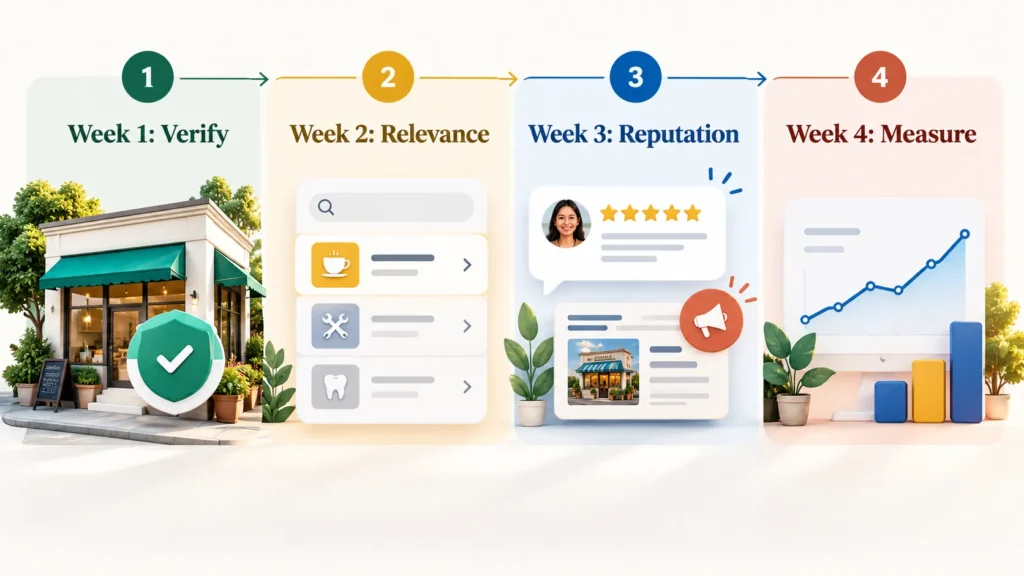
Week 1: Verify the Foundation
Check ownership and verification status. Confirm the company name matches real-world branding. Review business eligibility, address or hidden-address rules, map pin, primary category, hours, phone number, and linked website. Fix material mistakes before experimenting with marketing changes.
Create a simple baseline: current local visibility at several search points, existing customer reviews, common GBP search phrases, profile interactions, and the number of qualified leads. Record any issues that need support or additional verification rather than improvising risky workarounds.
Week 2: Strengthen Relevance
Add appropriate secondary categories and genuine services. Update helpful attributes, upload representative real photos, and ensure the website explains core offerings clearly. Review important service pages for accurate locations, working forms, and straightforward contact information.
Address any thin content that leaves customers uncertain. For example, make it clear whether weekend appointments are available, whether the company travels to customers, and which services require a quote. Information that reduces customer confusion can improve the experience regardless of a ranking change.
Week 3: Improve Reputation and Consistency
Introduce a simple, policy-compliant review request after completed customer interactions. Assign responsibility for responding to reviews, including complaints. Check major citations for wrong phone numbers, outdated addresses, or misleading duplicates; prioritize issues that affect customer trust.
Look for natural community relationships or industry organizations where the business has an authentic reason to be listed. Avoid buying bulk links and avoid any vendor who guarantees a Maps position. Document corrections and keep ownership credentials secure.
Week 4: Review Outcomes and Set Priorities
Compare local-grid visibility, profile interactions, and qualified leads with the baseline. Look for broad patterns, not isolated jumps. Identify questions customers still ask and improve the relevant pages or profile information. Continue collecting genuine feedback and keeping business details accurate.
At the end of the month, create a short recurring maintenance schedule: check hours before holidays, review new feedback, inspect profile edits, update important services, and report conversions. A consistent system prevents small errors from accumulating into larger problems.
Common Local SEO Mistakes to Avoid
Most damaging mistakes come from treating local search as a collection of loopholes. In reality, a reliable business identity, relevant information, and strong customer experience are safer and more sustainable than shortcuts.
- Keyword-stuffed business names: Adding services or city names not used in the real business name conflicts with Google’s identity guidelines.
- Fake offices and misleading map pins: Claiming an unstaffed location can create eligibility and suspension problems.
- Bought or gated reviews: Paying customers for reviews or soliciting only positive feedback damages trust and creates policy risk.
- Irrelevant categories: Selecting categories solely for search volume can make the listing less representative of the actual business.
- Mass-produced city pages: Repeating one generic page for dozens of cities adds little useful information to customers.
- Unverified ranking claims: Treating one expert’s preferred posting frequency as a Google-confirmed ranking requirement leads to misplaced effort.
- Rank tracking from one spot: A single map result is too narrow to describe a whole service area.
- Ignoring real conversions: More profile impressions are not the same as more appointments, qualified calls, or sales.
If your company is eligible but missing from the map results, investigate the problem methodically rather than changing ten fields at once. MSEOExpert’s guide to businesses not showing in Google’s Local Pack offers a useful related troubleshooting path.
Frequently Asked Questions
What factors influence Google Local Pack rankings in 2026?
Google identifies relevance, distance, and prominence as its central framework. Specific practical areas include GBP categories, business details, real-world location, legitimate customer reviews, website relevance, and credible outside references. Exact algorithm weights are not public, and search results can vary by user location.
What are Google’s three main local ranking factors?
The three factors are relevance, distance, and prominence. Relevance is how closely a business matches the search; distance considers location; and prominence concerns how well known or established the business appears. They work together rather than as a simple fixed-point formula.
How does Google Business Profile affect Local Pack rankings?
Google Business Profile provides essential information about a business’s category, services, location, hours, and contact details. Accurate, complete information helps Google understand relevant businesses and helps customers choose among them. Profile optimization does not eliminate the influence of distance or competition.
Is the primary Google Business Profile category a ranking factor?
The primary category is a leading factor in the 2026 expert survey, and Google’s guidelines emphasize selecting the most specific category that accurately represents the business. Choose the right category for the core business rather than the one with the most attractive search volume.
Do Google reviews affect Local Pack rankings in 2026?
Yes. Google’s official guidance states that more reviews and positive ratings can help local rankings. The safest approach is to improve customer experience, ask all genuine customers for honest feedback, and respond professionally. Never offer incentives in exchange for a review or a rating change.
Does proximity influence Google Maps rankings?
Yes. Distance is part of Google’s official ranking framework, so a business may appear differently across neighborhoods. The searcher’s location or the place mentioned in a query can influence results. Changing a service-area label does not create a new physical business location.
Do GBP photos and posts improve Local Pack rankings?
Photos and posts are useful for communicating with customers and improving the appeal of a listing. However, Google does not publish a guaranteed direct ranking benefit from a certain photo or posting frequency. Use genuine media and useful updates rather than a keyword-stuffed posting schedule.
How do service-area businesses rank in the Local Pack?
Eligible service-area businesses can appear in local results without publicly showing a residential address. They should use a genuine underlying location, accurate categories, and compliant service-area settings. Adding numerous distant service areas does not override Google’s distance considerations.
What changed in ranking factors from 2025 to 2026?
The most concrete new evidence is Whitespark’s 2026 expert survey, published in late 2025. It reflects greater expert emphasis on reviews and behavioral signals and adds AI-search visibility assessments. It does not prove Google made a specific public algorithm change on January 1, 2026.
Are citations still useful for Local Pack SEO?
Yes, especially when they prevent customers from encountering outdated or conflicting business information. Prioritize accurate, relevant listings and important duplicates. Avoid assuming that purchasing hundreds of new directory submissions will overcome weak relevance, poor reviews, or geographic distance.
Can I pay Google for better Local Pack placement?
No. Google states that businesses cannot request or pay for a better organic local ranking. Advertising placements are separate from unpaid local results. Evaluate a vendor’s promise of a guaranteed number-one Maps position with caution.
How long does it take to improve local rankings?
There is no universal timeline. Correcting a profile error may be reflected differently from earning a strong body of customer feedback or developing a useful local website. Measure progress over suitable periods, keep a change log, and judge success partly by qualified leads rather than rankings alone.
Where can I find Google’s official Local Pack ranking documentation?
Google maintains a Business Profile Help page titled “Tips to improve your local ranking on Google.” That page explains relevance, distance, prominence, and basic profile practices. Google also maintains separate eligibility, reviews, and business-information guidelines that should guide implementation.
Final Thoughts About Google Local Pack Ranking Factors
The most useful way to approach Google Local Pack ranking factors in 2026 is to separate what Google confirms from what industry researchers observe. Build around relevance, distance, and prominence. Correct the primary category and business facts, earn genuine reviews, improve useful website content, and maintain accurate citations. Treat photos, posts, and experimental tactics as supporting work rather than shortcuts.
Businesses that want a structured review of their profile, website, and local search presence can explore MSEOExpert’s Local SEO services for US businesses. The goal is not merely a higher position in one screenshot. It is more visibility to the right customers and more measurable business opportunities.
To pick up a draggable item, press the space bar. While dragging, use the arrow keys to move the item. Press space again to drop the item in its new position, or press escape to cancel.
To pick up a draggable item, press the space bar. While dragging, use the arrow keys to move the item. Press space again to drop the item in its new position, or press escape to cancel.